Why end-to-end
A telemetry product is not a device plus a server; it is a chain, and it is only as good as the assumptions shared across it. The number of bytes on the air dictates battery life. The protocol's keep-alive dictates how a sleeping modem is reached. The server's decoding rules must match the exact bit layout the firmware emits. When these are owned by separate vendors, the seams become the failures. IMPSPRGM builds the whole chain, so a decision made at the sensor is honoured all the way to the dashboard.
The environment we design for
Battery budgets measured in years, not hours. Links that are narrow, metered and frequently absent — a device in a basement, a pit or a rural cell edge. Firmware that must survive brown-outs mid-write. Fleets of thousands of units that have to be reached, trusted and updated without a site visit. Every competency below exists to make that environment survivable.
1 · Device & hardware engineering
Low-power, low-BOM device design around cellular and short-range silicon. We choose the silicon to the power and cost envelope, budget every microamp across the duty cycle, and lay out boards where the radio, the MCU and the sensors coexist without fighting for current or clock.
- Dual-chip nodes (GSM/GPRS module + 8/32-bit MCU), single-module EAT designs, and BLE-provisioned variants.
- Power budgeting: sleep/active-halt scheduling, anti-phase wake, brown-out-safe write windows.
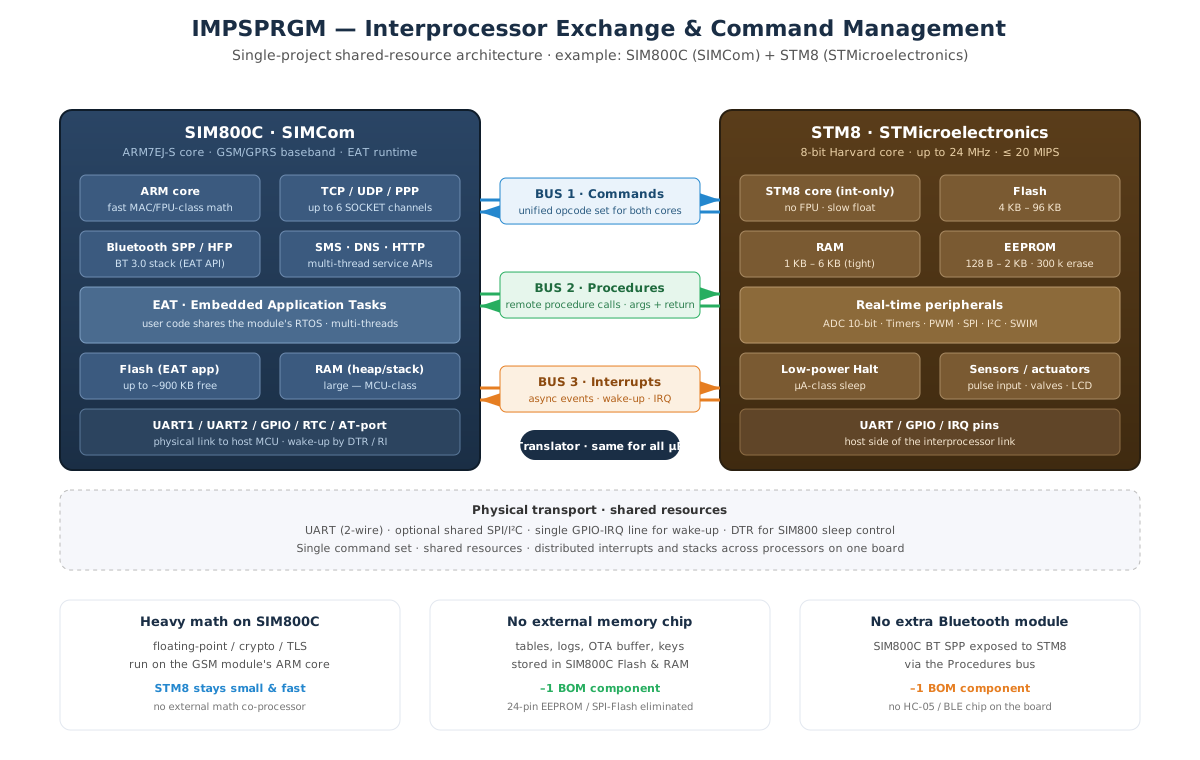
- BOM reduction through the IMPSPRGM Interprocessor OS — sharing the modem's flash, crypto and radio instead of adding discrete chips.
2 · Firmware & runtime
Bare-metal C and vendor runtimes on constrained parts, with the discipline that comes from having no room to be wasteful — kilobytes of RAM, no heap to speak of, no operating system to hide behind.
- Bare-metal C (SDCC / Cosmic on STM8), EAT / Embedded-AT multi-threaded apps inside the modem, driver and HAL work.
- The three-bus Translator runtime (Commands / Procedures / Interrupts) for cooperating cores.
- Field-safe firmware update via built-in bootloader and IAP — see Interprocessor OTA.
3 · Radio & connectivity
Getting bytes off a sleeping, power-starved device and onto a carrier reliably is its own discipline — registration, paging, roaming, ret/backoff, and knowing when not to transmit.
- Cellular: GSM/GPRS today, LTE-M and NB-IoT for low-power WAN; APN/roaming, PSM and eDRX sleep, network re-attach logic.
- Short-range: Bluetooth (SPP/HSP/HFP on the module) for local provisioning and diagnostics.
- Wake strategy: DTR/RI/GPIO lines to keep the modem in standby between windows and wake it in tens of milliseconds.
4 · Protocols
We pick the protocol to the link, not to fashion. On a metered narrowband channel every header byte and every keep-alive is a cost, so we run the full range from standard application protocols down to compact custom framing when the bytes matter.
| Layer | What we use | When |
|---|---|---|
| Transport | TCP, UDP | Persistent socket for chatty links; UDP for cheap, idempotent bursts. |
| Application | MQTT, MQTT-SN, CoAP, HTTP(S) | Broker-based fleets (MQTT); constrained/UDP nodes (MQTT-SN, CoAP); simple pull endpoints (HTTP). |
| Custom | Compact binary framing (bus tag + length + opcode + payload + CRC-16) | When header overhead or airtime dominates the energy budget. |
| Security | TLS / DTLS, keyed-HMAC message signing, monotonic anti-replay counters | Channel encryption where the silicon affords it; per-message authentication everywhere. |
Protocol economics
A "small" reading is rarely small once framing, TLS records and keep-alives are added. We measure the real byte cost of a message end to end, then move fixed metadata into provisioning, delta-encode the payload, and size the keep-alive to the network's paging behaviour — turning a chatty design into one a battery can afford for years.
5 · Data-collection servers
The device side is only half the system. We build the collection backend that terminates thousands of connections, decodes the exact byte layout the firmware emits, stores it for query, and drives the fleet back the other way.
- Ingress. TLS-terminating gateway / MQTT broker sized to hold many idle long-lived sockets from sleeping devices.
- Decode. A codec layer that turns the firmware's exact binary frames into typed readings — versioned so old and new firmware coexist during a rollout.
- Store. Time-series storage for measurements, with a relational registry for device identity, keys, firmware version and location.
- Serve. APIs and dashboards for operators; export to billing / SCADA / utility systems.
- Command back. Downlink queue, remote configuration, and the OTA campaign service that schedules and tracks fleet-wide updates.
6 · Security & provisioning
- Per-device identity and keys injected at manufacture; keys never leave the module's secure storage.
- Signed firmware and signed telemetry using the node's keyed hash; anti-rollback version counters.
- No externally exposed programming or debug port on shipped enclosures.
7 · Fleet operations
- Health monitoring: last-seen, signal, battery, firmware version per device.
- Remote configuration and staged OTA campaigns with automatic rollback — see Interprocessor OTA.
- Diagnostics that survive intermittent links: store-and-forward on the device, resume-on-reconnect on the server.
What "end to end" means in practice
Where this applies
- Utility metering (water, gas, electricity) with cellular backhaul and integrated data transfer.
- Industrial and environmental telemetry on battery power.
- Asset tracking and monitoring that needs local BLE provisioning plus a wide-area link.
- Any product where the device, the protocol and the server have to be co-designed to hit a cost, power or airtime target.
References & standards we work to
- OASIS — MQTT v3.1.1 / v5.0; MQTT-SN for UDP-constrained nodes.
- IETF — CoAP (RFC 7252); TLS 1.2/1.3 (RFC 8446); DTLS (RFC 6347/9147).
- 3GPP — LTE-M and NB-IoT low-power WAN features (PSM, eDRX).
- SIMCom & STMicroelectronics device documentation — see the Interprocessor OS and Interprocessor OTA articles.