Two packages make up this release: the transport-neutral IFP/2 core SDK (verified on a host compiler) and the Fabric 2.0 firmware pack that ports it to the R1/R2 boards and maps IFP/2 services onto the Quectel and SIMCom modems. Both are reference implementations, distributed under the IMPSPRGM licence.
✓ What is verified
The SDK core is built and tested on a host compiler with the strictest flags. These are the real results of this release:
$ cc -std=c99 -Wall -Wextra -Werror -O2 -Iinclude  src/*.c tests/test_main.c -o ifp2_tests
   (clean — no warnings, no errors)
$ make test
   IFP/2 SDK tests: PASS
$ python3 tools/verify_vectors.py
   01_hello OK   02_heartbeat OK   03_socket_connect OK   04_binary_event OK
   90_bad_header_crc OK   91_bad_payload_crc OK        (6/6 vectors, incl. 2 negative-CRC)
$ ./ifp2_minimal
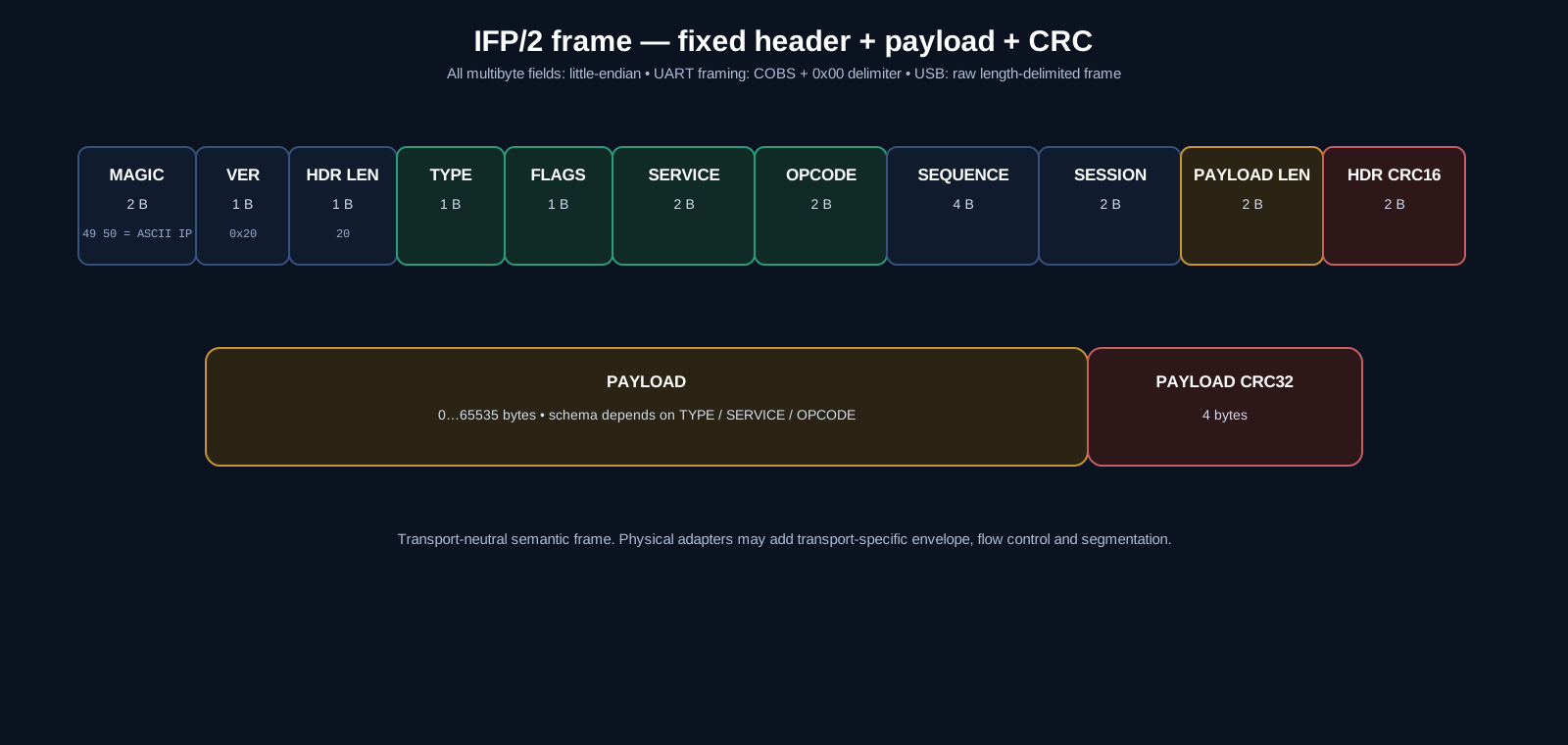
   49 50 20 14 ...   → MAGIC 0x4950 "IP", VERSION 0x20, HEADER_LEN 20  (spec-correct)
The firmware pack (R1/R2 board ports and modem providers) is a reference skeleton for on-target bring-up; its Generation-2 hardware qualification (72 h traffic, 1 000 resets, USB throughput, power budget) is a bench milestone in progress, not claimed as complete.
Downloads
IFP/2 Reference SDK
- Raw frame encoder/decoder · CRC16-CCITT-FALSE + CRC32/IEEE
- UART COBS envelope · allocation-free TLV writer/parser
- Service registry + recovery/session state skeleton
- Host unit tests · 6 canonical positive/negative vectors
- Make + CMake · minimal encoding example
Fabric 2.0 Firmware Pack · R1/R2
- R1 · STM32U575 port + Quectel EC200U (AT / QuecOpen) provider
- R2 · Renesas RA6M5 port + SIMCom SIM7672 (AT / Embedded AT) provider
- Common platform + AT transaction engine + provider interface
- Bring-up checklists, provider service map, implementation milestones
- Bundles the IFP/2 SDK for a self-contained integration
See also the frozen IFP/2 Specification v1.0 (PDF) and the Fabric 2.0 architecture.
What is in the SDK
A deterministic, dependency-free core. It performs no malloc() — every buffer is caller-owned or statically bounded — so it drops into a bare-metal loop, a cooperative scheduler or an RTOS task unchanged.
ifp2_frame.*— raw frame encode/decode, CRC16/CRC32, UART COBS envelope.ifp2_tlv.*— allocation-free TLV writer and iterator.ifp2_services.h— normative field IDs and transport bits.ifp2_registry.*— provider-side service registry.ifp2_state.*— protocol/recovery state skeleton.
Build on a host
make            # builds ifp2_tests + ifp2_minimal
make test       # -> IFP/2 SDK tests: PASS

# or with CMake:
cmake -S . -B build
cmake --build build
ctest --test-dir build --output-on-failure
For embedded integration, copy include/ifp2 and src into the firmware project and implement the platform hooks (platform_now_ms, platform_uart_send, platform_peer_reset, journal/power) separately. No vendor SDK header ever reaches the application layer — that is the core contract.
What is in the firmware pack (R1/R2)
The layer above the SDK: it splits the node into a deterministic MCU side (control, measurement, safety, IFP/2 core, transaction journal) and a provider side (the modem, exposing only capabilities its firmware actually implements). It deliberately does not invent pin numbers or vendor SDK calls — those are bound to the exact board revision and vendor documentation.
| Reference | Control path | Providers included |
|---|---|---|
| R1 · STM32U575 + Quectel EC200U | UART control · optional qualified USB bulk | EC200U AT provider · QuecOpen provider skeleton |
| R2 · Renesas RA6M5 + SIMCom SIM7672 | SCI/UART control · optional qualified USB bulk | SIM7672 AT provider · Embedded-AT provider skeleton |
Provider service map — capability-gated
A service exists only when the selected modem firmware actually implements it. Nothing is inferred from a model name.
| IFP/2 service | EC200U baseline | SIM7672 baseline | Rule |
|---|---|---|---|
| SYSTEM · HEALTH | local provider | local provider | required |
| NETWORK · SOCKET | AT or QuecOpen | AT or Embedded AT | required |
| MQTT · HTTP · SMS · STORAGE | documented API / socket app | documented API / socket app | capability-gated |
| GNSS · BLUETOOTH | only supported variant | only supported variant | never infer |
| COMPUTE · FOTA | project-defined job | project-defined job | provider-specific |
Implementation milestones
Bring-up is staged from board control to full qualification:
M0 Board control (power, reset, boot, console)   M4 Transactions (journal + query semantics)
M1 AT-only connectivity (NETWORK + SOCKET)       M5 Provider extension (QuecOpen / Embedded AT)
M2 IFP/2 control plane (frame/TLV/session)        M6 Bulk transport (USB qualification)
M3 Recovery (reset injection, resync, degraded)   M7 Qualification (72 h, 1000 resets, power/mem)
Status & scope (honest by design)
- The IFP/2 protocol is frozen for Generation 2; erratum v1.0.1 fixes the magic-byte ordering (compare bytes
0x49 0x50directly, not as a little-endian integer). - These packages are reference implementations / skeletons, not a modem-vendor SDK. Vendor APIs live behind the Provider Adapter only.
- Cryptographic transforms (SEC1/SEC2) are integration hooks, not embedded crypto in this release; CRC remains the normative transport integrity check.
- SPI/USB bulk and any specific chip pair are not marked production-validated until bench qualification (M6/M7) is measured.
Licensing
IMPSPRGM™ is proprietary technology of LLC IMPSPRGM (Tashkent, Uzbekistan), distributed under a written Licence Agreement on a per-unit basis. The IFP/2 protocol, the reference SDK and the firmware pack remain the property of LLC IMPSPRGM; redistribution and derivative works require prior written consent. Commercial inquiries: impsprgm@umail.uz · International PCT application PCT/UZ2022/050001.